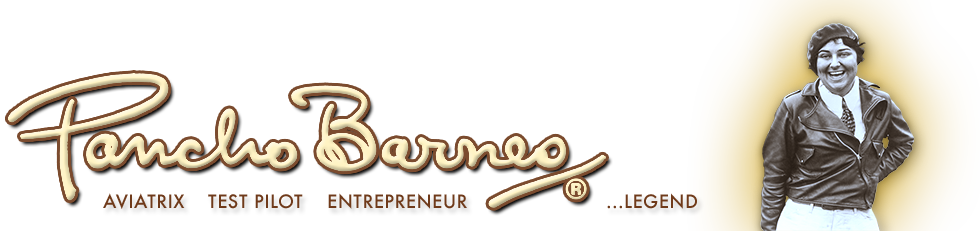
Pancho Barnes was inspired to pursue aviation at a very early age. Her grandfather, Professor Thaddeus Lowe, took her to the 1910 International Air Meet in Los Angeles at Dominguez Field when she was 8 years old. This was America’s first Air Meet. Her grandfather was an honored guest at this event because of his aeronautical accomplishments as a balloonist. Although sadly we have no photograph or published documentation in the Pancho Barnes Trust Estate Archive of her attendance, we do know that Pancho often recounted with fondness her grandfather’s influence on her, telling her friends that while at that event her grandfather leaned over and told her: “One day you will be flying one of those machines.” Many aviation historians believe that specific experience made a lasting impression on her.
While at the air meet, Pancho witnessed history unfolding right before her eyes. She saw pilots like Louis Paulhan, Glenn Curtiss, Charles Willard, and Lincoln Beachey take to the air.
Also in the viewing crowd that day was a young Jimmy Doolittle. Both Pancho and Doolittle weren’t just watching entertainment ……they were witnessing the birth of a new frontier. For Pancho, that day planted a seed. She grew up with a belief that the sky was a place for adventure, courage, and possibility….. not just for men, but for anyone bold enough to take it on. For Doolittle, it set him on the path to becoming one of America’s most celebrated aviators and heros.
The growing visibility of women aviators like Amelia Earhart, no doubt, also helped pave the way and inspire Pancho’s path. However, it was when her cousin, Dean Banks, took up flying in the late 1920’s that Pancho decided that she could and would get a pilots license as well. Amazingly, she soloed after just 6 hours of flying instruction, and her license is signed by non-other than Orville Wright.
Decades later, Pancho became a record-breaking pilot, stunt pilot, test pilot (for the Lockheed Aircraft Company, forerunner to what is now Lockheed-Martin) a leader in the aviation community, and a mentor to other women in flight. Her example lit the way for the next generation. In the decades that followed, Jerrie Mock circled the globe solo in 1964. Jeana Yeager, co-pilot of the Voyager in 1986, completed the first non-stop, non-refueled flight around the world, pushing the limits of endurance and technology. And Eileen Collins, breaking barriers in the 1990s, became the first woman to command a Space Shuttle mission, carrying Pancho’s legacy beyond the skies and into space. Together, these women form an unbroken chain of courage and accomplishment, proving that the path Pancho blazed still leads upward.
